🎉 Up to 70% Off Selected ItemsShop Sale
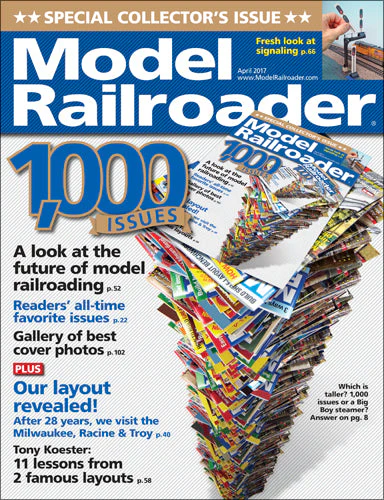
Model Railroader April 2017
Chasing the MR&Tby John Pete Jr.My name may ring a bell with you. My dad was Boomer Pete, whose name showed up often in Model Railroader long, long ago, back in the early years of the magazine’s history. Boomer, whose proper name was John, was a train buddy of one Albert C. Kalmbach, who founded Model Railroader.Boomer was a homespun model railroad nut like many of you all, and as a traveling man doing odd jobs, he got to meet lots of other railroad nuts. He wrote a semi-regular column in MR.The future of model railroadingby Lance MindheimLooking in the rear view mirror, it's astounding how far our hobby has come in the past few decades. Wireless Digital Control, onboard sound, and rolling stock bristling with fine scale details top the list. Looking forward, what exciting advances does the next decade or two hold for us?What follows is somewhat of a blend between advances I think will happen in the short term and advances I believe would be in the best interest of the hobby as a whole if they did occur. Just because I believe a system or technology would in everybody's best interest doesn't mean the market will agree.11 lessons learned from building two model railroadsby Tony KoesterWhen I contemplated replacing my Allegheny Midland RR with a new HO model railroad, I distinctly remember thinking it should be a relatively easy project. After all, I had essentially finished one basement-size railroad, so doing another should be a piece of cake. How naïve of me on numerous counts!You’ve heard that “the more things change, the more they stay the same.” That adage has a very limited application to model railroading, I discovered. Over the quarter-century that the Allegheny Midland resided in my New Jersey basement, “things” changed a great deal. I thought I was keeping the AM up to date, but some seismic shifts in our options caused me to have to rethink almost everything I thought I understood to be a best practice.A signal system to fit any railroadby Bruce CarpenterOn most operationally based model railroads, a working signal system seems to be on everyone’s wish list, in one form or another. I fell into that category when I built my HO scale BNSF Ry. Chillicothe Subdivision and my HO scale Milwaukee Road Rocky Mountain Division.There are lots of things to consider when thinking about signals, though. Do you install them with relays or use one of the many computer-based systems? Do you build a Centralized Traffic Control (CTC) machine or use a computer monitor? Regardless, it’s a lot of design, research, wiring, programming, time, and especially, money.Union Pacific's Spine Line in HO and Nby Bob SpragueThe Union Pacific has some of the more colorfully named routes in the country. The “Rabbit Line” runs through East Texas, the “Tucumcari Line” connects Kansas and New Mexico, and the famous “Feather River Corridor” is in California. Running up the middle of the North American continent, from Kansas City northward to St. Paul, is UP’s aptly named “Spine Line.”As a professional track plan designer, I was asked to develop an N scale version of the Spine Line that fit into a 10 x 171⁄2-foot space at one end of a basement room. Just about the time I finished that design, my client told me he had a friend who also wanted to model the Spine Line in an identical space – only this time, in HO. Fitting a satisfying model into the same square footage in that larger scale required a different approach, but the Âresults may be useful for anyone trying to represent a Âsingle-track Midwestern prototype in a modest space.How to build a big model industryby Cody Grivno, associate editorMy assignment for the Beer Line project layout was to model the Ben-Hur Freezer Co. The building, located at 634 E. Keefe Ave. in Milwaukee, is still standing, but now subdivided and used by several smaller businesses. Though the prototype structure still existed, I faced the dilemma of modeling an approximately 325 x 400-foot building in just 17 x 31 inches.Instead of compressing the building, I tried to capture its flavor. Using satellite images from Bing, Google, and Historic Aerials (www.historicaerials.com), I could see the building had 12 rows of large sawtooth skylights, typical of those found on industries during the 1940s and earlier. Smaller ridge-style skylights with gable ends were used elsewhere.Build a modern grade crossingby Pelle SøeborgWhen you model the Midwest, there are some things you can’t leave out: a grain elevator, a small town, and last but not least, a grade crossing. Many small towns in the Midwest were established around the railroad, and most of them have at least one grade crossing.It can be a challenge to find the items needed to build a modern grade crossing. I used two of Walthers modern cantilever crossing signals; a set of non-operational crossing gates from NJ International, which I modified so they could be operated by a Tortoise by Circuitron switch machine; BLMA modern concrete crossing panels; and a Logic Rail Technologies Grade Crossing Pro circuit board kit.
Product Information
Product Information
Shipping & Returns
Shipping & Returns
Model Railroader April 2017
Model Railroader April 2017
Chasing the MR&Tby John Pete Jr.My name may ring a bell with you. My dad was Boomer Pete, whose name showed up often in Model Railroader long, long ago, back in the early years of the magazine’s history. Boomer, whose proper name was John, was a train buddy of one Albert C. Kalmbach, who founded Model Railroader.Boomer was a homespun model railroad nut like many of you all, and as a traveling man doing odd jobs, he got to meet lots of other railroad nuts. He wrote a semi-regular column in MR.The future of model railroadingby Lance MindheimLooking in the rear view mirror, it's astounding how far our hobby has come in the past few decades. Wireless Digital Control, onboard sound, and rolling stock bristling with fine scale details top the list. Looking forward, what exciting advances does the next decade or two hold for us?What follows is somewhat of a blend between advances I think will happen in the short term and advances I believe would be in the best interest of the hobby as a whole if they did occur. Just because I believe a system or technology would in everybody's best interest doesn't mean the market will agree.11 lessons learned from building two model railroadsby Tony KoesterWhen I contemplated replacing my Allegheny Midland RR with a new HO model railroad, I distinctly remember thinking it should be a relatively easy project. After all, I had essentially finished one basement-size railroad, so doing another should be a piece of cake. How naïve of me on numerous counts!You’ve heard that “the more things change, the more they stay the same.” That adage has a very limited application to model railroading, I discovered. Over the quarter-century that the Allegheny Midland resided in my New Jersey basement, “things” changed a great deal. I thought I was keeping the AM up to date, but some seismic shifts in our options caused me to have to rethink almost everything I thought I understood to be a best practice.A signal system to fit any railroadby Bruce CarpenterOn most operationally based model railroads, a working signal system seems to be on everyone’s wish list, in one form or another. I fell into that category when I built my HO scale BNSF Ry. Chillicothe Subdivision and my HO scale Milwaukee Road Rocky Mountain Division.There are lots of things to consider when thinking about signals, though. Do you install them with relays or use one of the many computer-based systems? Do you build a Centralized Traffic Control (CTC) machine or use a computer monitor? Regardless, it’s a lot of design, research, wiring, programming, time, and especially, money.Union Pacific's Spine Line in HO and Nby Bob SpragueThe Union Pacific has some of the more colorfully named routes in the country. The “Rabbit Line” runs through East Texas, the “Tucumcari Line” connects Kansas and New Mexico, and the famous “Feather River Corridor” is in California. Running up the middle of the North American continent, from Kansas City northward to St. Paul, is UP’s aptly named “Spine Line.”As a professional track plan designer, I was asked to develop an N scale version of the Spine Line that fit into a 10 x 171⁄2-foot space at one end of a basement room. Just about the time I finished that design, my client told me he had a friend who also wanted to model the Spine Line in an identical space – only this time, in HO. Fitting a satisfying model into the same square footage in that larger scale required a different approach, but the Âresults may be useful for anyone trying to represent a Âsingle-track Midwestern prototype in a modest space.How to build a big model industryby Cody Grivno, associate editorMy assignment for the Beer Line project layout was to model the Ben-Hur Freezer Co. The building, located at 634 E. Keefe Ave. in Milwaukee, is still standing, but now subdivided and used by several smaller businesses. Though the prototype structure still existed, I faced the dilemma of modeling an approximately 325 x 400-foot building in just 17 x 31 inches.Instead of compressing the building, I tried to capture its flavor. Using satellite images from Bing, Google, and Historic Aerials (www.historicaerials.com), I could see the building had 12 rows of large sawtooth skylights, typical of those found on industries during the 1940s and earlier. Smaller ridge-style skylights with gable ends were used elsewhere.Build a modern grade crossingby Pelle SøeborgWhen you model the Midwest, there are some things you can’t leave out: a grain elevator, a small town, and last but not least, a grade crossing. Many small towns in the Midwest were established around the railroad, and most of them have at least one grade crossing.It can be a challenge to find the items needed to build a modern grade crossing. I used two of Walthers modern cantilever crossing signals; a set of non-operational crossing gates from NJ International, which I modified so they could be operated by a Tortoise by Circuitron switch machine; BLMA modern concrete crossing panels; and a Logic Rail Technologies Grade Crossing Pro circuit board kit.
$9.99
Model Railroader April 2017—
$9.99
Product Information
Product Information
Shipping & Returns
Shipping & Returns
Description
Chasing the MR&Tby John Pete Jr.My name may ring a bell with you. My dad was Boomer Pete, whose name showed up often in Model Railroader long, long ago, back in the early years of the magazine’s history. Boomer, whose proper name was John, was a train buddy of one Albert C. Kalmbach, who founded Model Railroader.Boomer was a homespun model railroad nut like many of you all, and as a traveling man doing odd jobs, he got to meet lots of other railroad nuts. He wrote a semi-regular column in MR.The future of model railroadingby Lance MindheimLooking in the rear view mirror, it's astounding how far our hobby has come in the past few decades. Wireless Digital Control, onboard sound, and rolling stock bristling with fine scale details top the list. Looking forward, what exciting advances does the next decade or two hold for us?What follows is somewhat of a blend between advances I think will happen in the short term and advances I believe would be in the best interest of the hobby as a whole if they did occur. Just because I believe a system or technology would in everybody's best interest doesn't mean the market will agree.11 lessons learned from building two model railroadsby Tony KoesterWhen I contemplated replacing my Allegheny Midland RR with a new HO model railroad, I distinctly remember thinking it should be a relatively easy project. After all, I had essentially finished one basement-size railroad, so doing another should be a piece of cake. How naïve of me on numerous counts!You’ve heard that “the more things change, the more they stay the same.” That adage has a very limited application to model railroading, I discovered. Over the quarter-century that the Allegheny Midland resided in my New Jersey basement, “things” changed a great deal. I thought I was keeping the AM up to date, but some seismic shifts in our options caused me to have to rethink almost everything I thought I understood to be a best practice.A signal system to fit any railroadby Bruce CarpenterOn most operationally based model railroads, a working signal system seems to be on everyone’s wish list, in one form or another. I fell into that category when I built my HO scale BNSF Ry. Chillicothe Subdivision and my HO scale Milwaukee Road Rocky Mountain Division.There are lots of things to consider when thinking about signals, though. Do you install them with relays or use one of the many computer-based systems? Do you build a Centralized Traffic Control (CTC) machine or use a computer monitor? Regardless, it’s a lot of design, research, wiring, programming, time, and especially, money.Union Pacific's Spine Line in HO and Nby Bob SpragueThe Union Pacific has some of the more colorfully named routes in the country. The “Rabbit Line” runs through East Texas, the “Tucumcari Line” connects Kansas and New Mexico, and the famous “Feather River Corridor” is in California. Running up the middle of the North American continent, from Kansas City northward to St. Paul, is UP’s aptly named “Spine Line.”As a professional track plan designer, I was asked to develop an N scale version of the Spine Line that fit into a 10 x 171⁄2-foot space at one end of a basement room. Just about the time I finished that design, my client told me he had a friend who also wanted to model the Spine Line in an identical space – only this time, in HO. Fitting a satisfying model into the same square footage in that larger scale required a different approach, but the Âresults may be useful for anyone trying to represent a Âsingle-track Midwestern prototype in a modest space.How to build a big model industryby Cody Grivno, associate editorMy assignment for the Beer Line project layout was to model the Ben-Hur Freezer Co. The building, located at 634 E. Keefe Ave. in Milwaukee, is still standing, but now subdivided and used by several smaller businesses. Though the prototype structure still existed, I faced the dilemma of modeling an approximately 325 x 400-foot building in just 17 x 31 inches.Instead of compressing the building, I tried to capture its flavor. Using satellite images from Bing, Google, and Historic Aerials (www.historicaerials.com), I could see the building had 12 rows of large sawtooth skylights, typical of those found on industries during the 1940s and earlier. Smaller ridge-style skylights with gable ends were used elsewhere.Build a modern grade crossingby Pelle SøeborgWhen you model the Midwest, there are some things you can’t leave out: a grain elevator, a small town, and last but not least, a grade crossing. Many small towns in the Midwest were established around the railroad, and most of them have at least one grade crossing.It can be a challenge to find the items needed to build a modern grade crossing. I used two of Walthers modern cantilever crossing signals; a set of non-operational crossing gates from NJ International, which I modified so they could be operated by a Tortoise by Circuitron switch machine; BLMA modern concrete crossing panels; and a Logic Rail Technologies Grade Crossing Pro circuit board kit.